
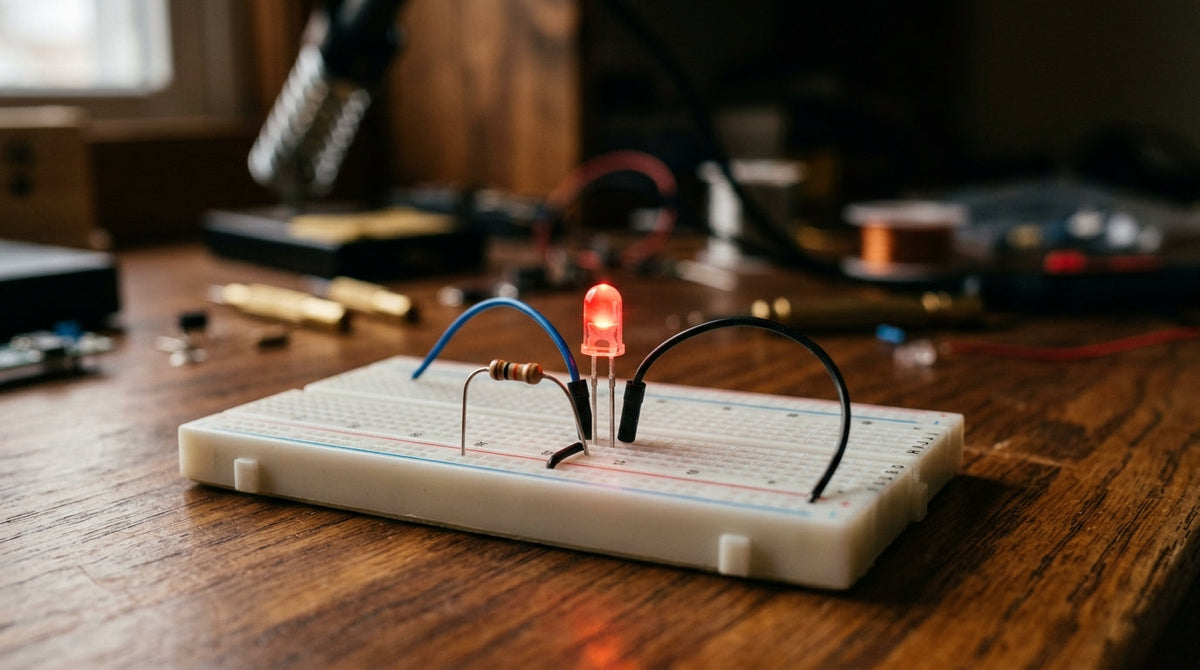
Connect an LED straight across a 9 volt battery and it will flash once and die. The LED is not faulty. It was simply given no limit, and an LED will not limit current for itself.
Why it happens
An LED is a diode. Below a certain voltage, called the forward voltage, almost no current flows. Just above it, the current climbs very steeply. There is no gentle middle ground, so something else in the circuit has to set the current. That something is a series resistor.
Working out the value
R = (supply voltage − LED forward voltage) ÷ LED current
Red, yellow and green LEDs have a forward voltage of roughly 2 volts. Blue and white are nearer 3 volts. Most small LEDs are rated for 20 mA at most, and are comfortably bright at 10 mA.
- Red LED on 9 volts at 10 mA: (9 − 2) ÷ 0.010 = 700 Ω. Use 680 Ω or 1 kΩ.
- Red LED on 5 volts at 10 mA: (5 − 2) ÷ 0.010 = 300 Ω. Use 330 Ω.
If you do not have the exact value, go up, not down. A larger resistor only makes the LED slightly dimmer.
Which way round
The longer lead is the anode and goes towards positive. The shorter lead, on the side where the rim of the case is flattened, is the cathode. An LED fitted backwards on a low-voltage supply will not light and usually is not harmed; turn it round and try again.
The resistor can go on either side of the LED. In a series circuit the same current flows through both.
If you want the fundamentals in one place, with hand-drawn diagrams, start with Getting Started in Electronics, or browse all four books.