
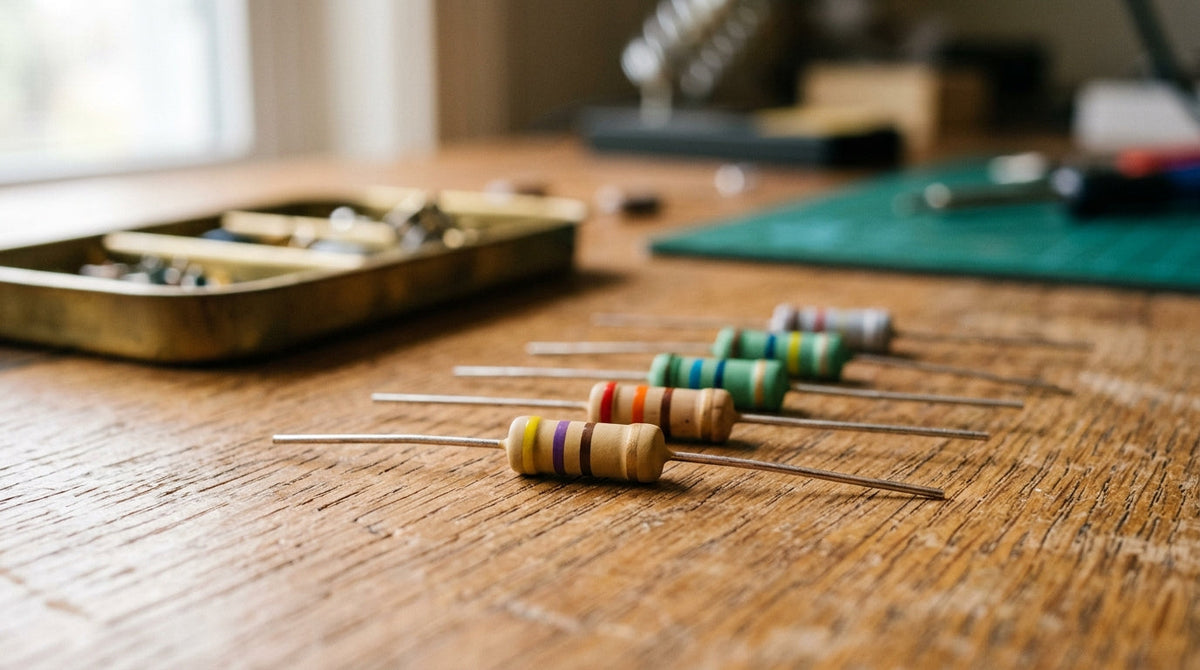
Small resistors are too small to print numbers on, so their value is painted on as coloured bands. The code looks arbitrary until you notice the middle of it is simply the rainbow.
The ten colours
Black 0, brown 1, red 2, orange 3, yellow 4, green 5, blue 6, violet 7, grey 8, white 9. Red to violet is the rainbow in order, with black and brown below it and grey and white above.
Four bands
The first two bands are digits. The third is the multiplier: the number of zeros to add. The fourth, set slightly apart, is the tolerance. Gold means 5 percent, silver 10 percent.
Yellow, violet, red, gold: 4, 7, then two zeros. That is 4,700 Ω, or 4.7 kΩ, within 5 percent.
Five bands
Precision resistors have three digit bands, then the multiplier, then the tolerance. Brown as the last band means 1 percent.
Brown, black, black, red, brown: 1, 0, 0, then two zeros. That is 10,000 Ω, or 10 kΩ, within 1 percent.
Which end to start from
- The tolerance band usually has a wider gap before it.
- Gold and silver are never the first band.
- If a reading gives a value that does not exist in the standard series, try it from the other end.
When you are unsure, measure. Colours on small parts are hard to tell apart under warm light, and a multimeter settles the question in seconds. There is more on component markings on our page about The Code.
If you want the fundamentals in one place, with hand-drawn diagrams, start with Getting Started in Electronics, or browse all four books.