
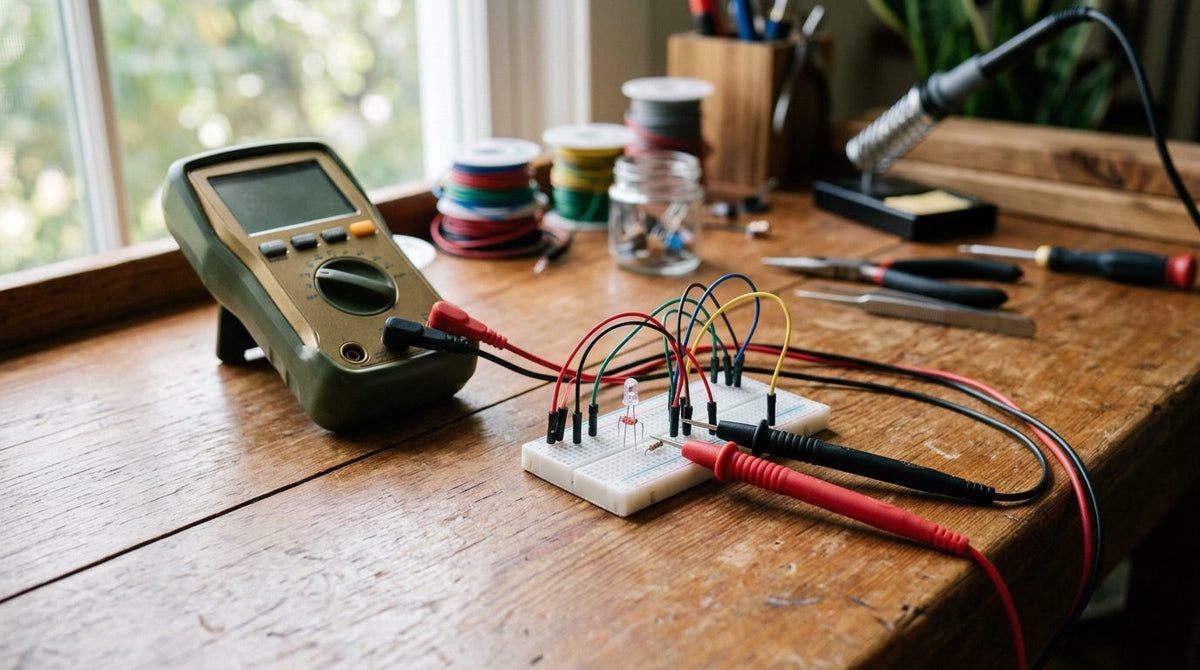
Every builder knows the moment: the last wire goes in, the battery goes on, and nothing happens. A dead circuit is almost never a mystery. It is usually one of a short list of faults, and checking them in order is quicker than staring at the board.
1. Is power really there?
Measure the supply voltage at the battery, then at the board, then directly on the power pins of the chip. A flat battery, a loose clip, or a power rail that is split in the middle of the breadboard accounts for a surprising share of failures.
2. Is ground shared?
Every part of the circuit needs a path back to the negative side of the supply. One missing ground wire stops everything downstream.
3. Is anything backwards?
LEDs, diodes, electrolytic capacitors, transistors and chips all have a right way round. Check the long lead of each LED, the stripe on each capacitor, and the notch that marks pin 1 on each chip.
4. Is every wire where the schematic says?
Go through the schematic one connection at a time and tick each off as you confirm it on the board. Being one breadboard row out is the classic error, and you will not see it until you count holes.
5. Split the circuit in half
If it still does nothing, test stage by stage. Does the first stage produce the voltage you expect? If yes, the fault is later. If no, it is earlier. Each test halves the search.
And if a part is hot, disconnect power straight away. Heat means current is flowing somewhere it should not.
If you want the fundamentals in one place, with hand-drawn diagrams, start with Getting Started in Electronics, or browse all four books.